

Why is outsourcing worth it?
Outsourcing, or delegating specific business processes to external service providers, has become an integral part of the strategy of many organizations. But why do companies choose this solution? Let's take a look at the benefits outsourcing can offer.
Reduced operating costs
One of the main reasons companies choose outsourcing is cost reduction. Instead of investing in recruitment, training, and employee retention, organizations can delegate specific tasks to external specialists, which is often a more cost-effective solution.
Remember!
According to a KPMG report, nearly 65% of surveyed companies use outsourcing for accounting, tax, and legal services, allowing them to achieve significant cost savings.
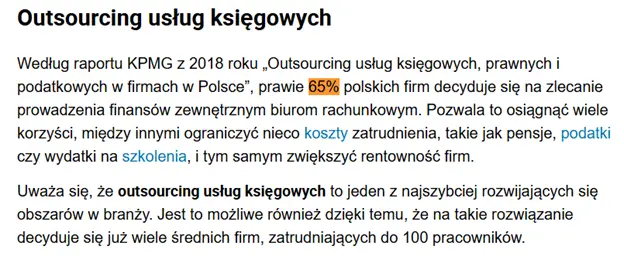
Statistics on the use of outsourcing in accounting services. Source: www.infor.pl/biura-rachunkowe/prowadze-biuro/5173897,Technologie-w-ksiegowosci-co-zmieni-sie-w-2021-r.html
Access to specialized expertise
Outsourcing provides access to highly skilled professionals without the need to employ them on a permanent basis. A good example is DPO outsourcing, where an external provider assumes the role of Data Protection Officer, helping ensure compliance with GDPR requirements.
"Effective supervision of personal data protection is only possible when a person or team is designated as responsible for GDPR-related matters." – Maciej Kaczmarski, President of the Management Board, ODO 24.
Scalability and flexibility
Outsourcing allows organizations to adjust resources according to current business needs. During periods of increased demand, the scope of services can be expanded quickly. During quieter periods, services can be scaled back accordingly. This level of flexibility is often difficult to achieve with permanent in-house staffing.
Focus on core competencies
By delegating non-core activities to external providers, organizations can focus on their primary business objectives. This enables companies to improve efficiency and strengthen their competitive position in the market.
"Outsourcing allows companies to focus on their core competencies while entrusting specialists with tasks outside their primary area of activity." – Paweł Radecki, Compliance Expert, ODO 24.
Risk management and regulatory compliance
In an evolving regulatory environment, outsourcing can help organizations manage risk and maintain compliance with applicable laws and regulations. A good example is GDPR implementation, where external specialists assist organizations in meeting personal data protection requirements and maintaining ongoing compliance.
Summary
Outsourcing is a strategic tool that offers numerous benefits:
- reduced operating costs;
- access to specialized expertise;
- flexibility and scalability;
- the ability to focus on core competencies;
- improved risk management and regulatory compliance.
However, the decision to outsource should be carefully considered and tailored to the specific needs and circumstances of the organization.

