

How much does GDPR documentation cost?
Did you know that properly prepared GDPR documentation is not only a compliance requirement but also an investment in your company's data security? The cost of developing GDPR documentation can depend on many factors—from the complexity of an organization's structure to the scope of personal data processing activities. Let's take a closer look at what affects the price and why it may sometimes be worth considering DPO outsourcing.
DPO outsourcing – outsourcing the Data Protection Officer function
What makes up the cost of GDPR documentation?
GDPR documentation is much more than a collection of legal documents. It is a living framework that describes an organization's data protection procedures and includes policies, registers, risk assessments, and other essential elements. For example, a complete GDPR documentation package should include:
- Record of Processing Activities (ROPA) – a detailed inventory of all operations the organization performs on personal data;
- Risk Assessment and Data Protection Impact Assessment (DPIA) – a requirement arising directly from Article 35 of GDPR, helping organizations identify and mitigate risks while reducing exposure to potential penalties.
What are the typical price ranges?
The cost of preparing GDPR documentation in the Polish market generally ranges from PLN 3,000 to PLN 12,000, depending on the organization's characteristics and the level of complexity required.
- Small organizations that process a limited amount of personal data typically pay between PLN 3,000 and PLN 5,000.
- Medium-sized and large organizations with more complex structures and larger workforces may incur costs exceeding PLN 10,000.
"Properly developing GDPR documentation is a costly but necessary investment that protects organizations from significant financial penalties." – Paweł Radecki, Compliance Expert, ODO 24.
Why do prices vary?
Several factors influence the cost of GDPR documentation:
Company size
The greater the number of personal data processing activities, the more extensive and complex the documentation becomes.
Industry sector
Certain industries, such as healthcare and financial services, are subject to stricter regulations and therefore require more detailed analyses and compliance measures.
Level of automation
IT systems that process personal data—such as CRM platforms and other business applications—often require additional procedures, controls, and documentation.
The added value of DPO outsourcing
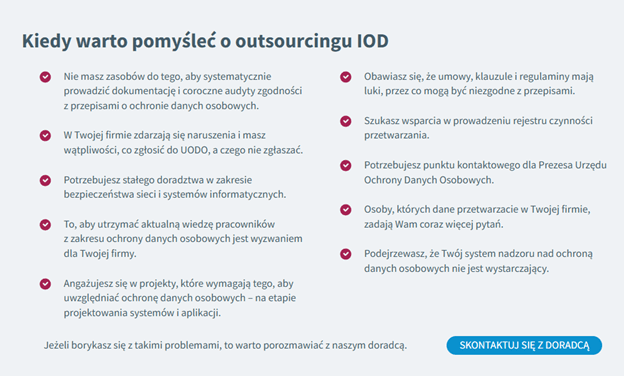
An increasing number of organizations choose to work with external Data Protection Officers. DPO outsourcing is a flexible solution that relieves internal teams while providing professional data protection support. Working with an external expert enables organizations to:
- keep documentation up to date;
- receive ongoing compliance guidance;
- obtain support during audits and inspections;
- adapt quickly to regulatory changes.
GDPR implementation as an investment
Money invested in GDPR implementation can have a direct impact on customer trust and the overall security of business operations. In 2022, nearly PLN 3.8 million in fines were imposed in Poland for violations related to personal data protection. These cases demonstrate that professional GDPR compliance services can help organizations avoid costly legal and regulatory consequences in the long run.
"Companies often postpone GDPR implementation, but growing awareness of risks and increasing penalties in Poland are encouraging businesses to take a more proactive approach." – Katarzyna Szczypińska, Data Protection Expert, ODO 24.
GDPR support services – ongoing assistance
After implementing GDPR documentation, organizations should also consider ongoing GDPR support services. Continuous support helps ensure that:
- personal data protection requirements are consistently met;
- documentation remains current and compliant;
- the organization stays informed about legal updates and best practices;
- financial and regulatory risks are minimized.
By maintaining ongoing compliance efforts, companies can not only satisfy legal requirements but also build a stronger foundation for long-term data protection and information security.

