

Why do companies choose outsourcing?
Outsourcing is a business strategy that can significantly reduce operating costs while improving efficiency. Companies delegate selected tasks to external providers so they can focus on their core competencies, while more complex, specialized, or compliance-related activities are handled by experts. This approach, widely adopted since the 1990s, became increasingly popular in Poland after 2004, when many organizations began integrating global standards for cost management and operational excellence.
"Outsourcing is a way to build operational advantage—it provides access to top specialists and enables businesses to scale quickly." – Maciej Kaczmarski, President of the Management Board, ODO 24.
Cost Savings and Access to Specialized Expertise
One of the primary reasons organizations choose outsourcing is cost optimization. Key benefits include:
- avoiding the high costs associated with hiring and retaining in-house specialists, including salaries, insurance contributions, and employee benefits;
- reducing investments in training, equipment, and software required to develop internal capabilities;
- gaining access to advanced technologies, tools, and procedures already established by external providers;
- accelerating the implementation of new solutions while lowering overall costs.
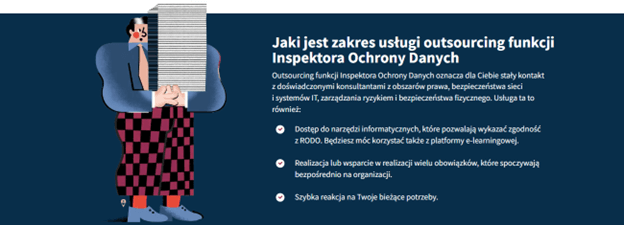
A common example is DPO outsourcing, which enables organizations to comply with GDPR requirements without employing a full-time in-house specialist. By outsourcing the DPO role, companies gain access to experienced professionals who can oversee data protection compliance and provide expert guidance on regulatory obligations.
Scalability and Flexibility
Businesses, particularly small and medium-sized enterprises (SMEs), increasingly use outsourcing to respond more effectively to changing market conditions. Outsourcing allows organizations to scale resources up or down, adapt quickly to new regulatory requirements, and respond efficiently to fluctuations in demand without long-term staffing commitments.
How does this work in practice?
Many SMEs outsource their Data Protection Officer function to better manage changing legal requirements and evolving data protection obligations.
DPO outsourcing supports organizations by providing:
- specialized knowledge – ensuring GDPR compliance without requiring internal expertise;
- flexibility – adapting to regulatory changes without allocating additional internal resources;
- focus on core objectives – relieving the organization of day-to-day data protection responsibilities, allowing management and employees to focus on core business activities.
According to a Deloitte report published in 2022, approximately 70% of companies worldwide use outsourcing as a tool for scaling organizational resources.
"Outsourcing provides an opportunity for sustainable growth with minimal risk, particularly in the areas of data protection and IT security." – Justyna Pergałowska, Data Protection Specialist, ODO 24.
Access to Specialized Services and Know-How
External service providers often possess expertise and experience that would be difficult—or sometimes impossible—for companies to develop internally. This is especially true in highly specialized areas such as GDPR implementation and ongoing GDPR compliance management, which require not only specialized knowledge but also continuous updates to procedures in line with changing legal requirements. Outsourcing helps reduce the risk of mistakes that could result in substantial financial penalties or compliance failures.
Enhanced Security and Risk Reduction
Outsourcing can also help organizations reduce risk, particularly in areas such as:
- Information Technology (IT),
- data security,
- compliance and regulatory management.
For example, outsourcing IT security and data protection services provides access to professionals with current knowledge of cybersecurity threats, security technologies, incident response procedures, and regulatory developments. Research from McKinsey & Company in 2021 found that 65% of companies increased their outsourcing budgets for IT services to strengthen their defenses against cyberattacks.
Summary
Outsourcing is an effective strategy that allows organizations to concentrate on their most important business activities while leveraging external expertise. The main reasons companies choose outsourcing include:
- lower operating costs;
- access to specialized knowledge and expertise;
- greater flexibility and scalability;
- improved compliance and risk management;
- enhanced IT and data security;
- faster implementation of new processes and technologies.
As a result, an increasing number of organizations are partnering with external service providers to improve efficiency, maintain compliance, and support sustainable business growth.

