

How should a DPO monitor data processing?
Regular audits and reviews
The foundation of effective monitoring is conducting regular internal audits. The DPO should monitor whether data processing activities comply with GDPR requirements and the organization's internal policies. As part of their duties, the DPO may recommend conducting compliance audits and support the data controller in organizing them, for example by providing expert guidance, helping prepare audit plans, or offering advice throughout the process. However, responsibility for planning and conducting the audit rests with the data controller. In 2022, the Polish Data Protection Authority (UODO) recorded 12,772 data breach notifications, highlighting the importance of regular audits in identifying potential risks.
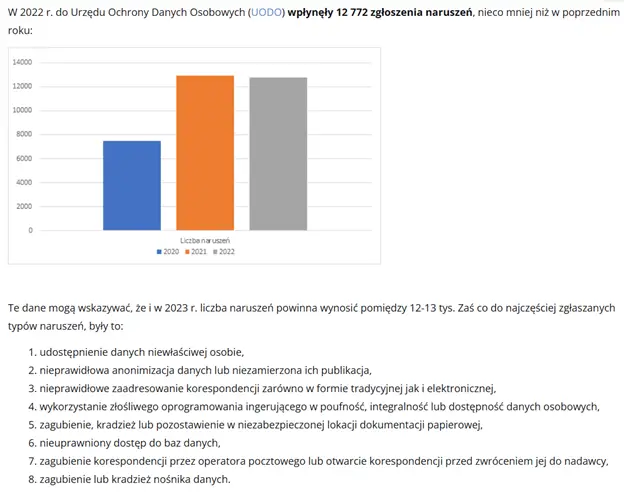
List of breaches according to UODO. Source: www.gdpr.pl/sprawozdanie-uodo-za-2022-r-tendencje-i-statystyki
Training and awareness building
Employee education is another key element. The DPO should monitor whether the organization provides training sessions and awareness campaigns and, where necessary, recommend improvements that increase employee awareness of personal data protection requirements.
Remember!
An informed workforce is the first line of defense against data breaches.
Cooperation with IT and security departments
Close cooperation with IT and information security teams is essential. The DPO should be involved in the implementation of new technologies, systems, and applications to ensure that they comply with GDPR requirements. Guidelines issued by the European Data Protection Board (EDPB) in 2022 emphasize the importance of technical and organizational security measures in protecting personal data.
Data Protection Impact Assessment (DPIA)
Before introducing new data processing activities, the DPO should conduct or support a Data Protection Impact Assessment (DPIA). This helps identify and minimize potential risks associated with the processing of personal data.
Monitoring breaches and responding to incidents
The DPO continuously monitors incidents related to data protection. In the event of a personal data breach, it is the responsibility of the data controller to:
- assess the risks associated with the incident;
- report the breach to the supervisory authority (UODO);
- notify affected individuals when required by law.
The Data Protection Officer plays an important supporting role throughout this process by providing advice and expert guidance. The DPO may assist with:
- risk analysis;
- preparation of documentation;
- ensuring that the controller's actions comply with GDPR requirements.
However, responsibility for making decisions and taking action remains solely with the data controller. In 2020, 8,635 personal data breaches were reported in Poland, placing the country fourth in Europe in terms of the number of reported incidents.
Documentation and reporting
Maintaining accurate documentation is essential. The Data Protection Officer oversees activities related to personal data processing within the organization and the maintenance of appropriate records. The DPO monitors compliance with GDPR requirements, initiates corrective actions, and intervenes when specific measures should be taken, such as:
- conducting training;
- performing an audit;
- analyzing an incident.
The DPO advises and supports the data controller in fulfilling legal obligations, while responsibility for decision-making remains with the controller. Regular reporting to the organization's management ensures transparency and enables informed decision-making.
Continuous improvement and knowledge updates
Data protection regulations and technologies continue to evolve. For this reason, one of the DPO's responsibilities is to continuously update their knowledge through professional training, conferences and workshops, and monitoring the latest guidance issued by the EDPB and UODO.
"Effective monitoring of data processing by a DPO is not only a legal obligation but, above all, the foundation for building trust with customers and business partners." – Paweł Radecki, Compliance Expert, ODO 24.
Summary
By supporting the data controller and overseeing personal data protection activities, the DPO helps ensure compliance with legal requirements while minimizing the risk of data breaches and potential financial penalties. It is also worth remembering that DPO outsourcing can be an effective solution for organizations that lack the internal resources necessary to perform these responsibilities.

