

What qualifications should a Data Protection Officer have?
Data Protection Officer (DPO) is a key figure within an organization, responsible for monitoring the processing of personal data and supporting the data controller in this area. In the era of GDPR and increasing regulatory requirements, their competencies must be of the highest standard. Let's take a closer look at the qualifications that are essential for this role.
Education and specialist knowledge
GDPR provisions (Articles 37–39) define the requirements for Data Protection Officers. However, it is important to remember that only through the interpretation of these provisions can we determine what expectations should be placed on a DPO. Although no specific level of education is prescribed, the following are expected:
- in-depth knowledge of data protection regulations – especially GDPR and national legislation, such as the Polish Personal Data Protection Act of May 10, 2018;
- an understanding of IT technologies and the risks associated with them – particularly in the area of information security;
- advisory and analytical skills – necessary for recommending solutions that are compliant with legal requirements and aligned with the interests of the organization.
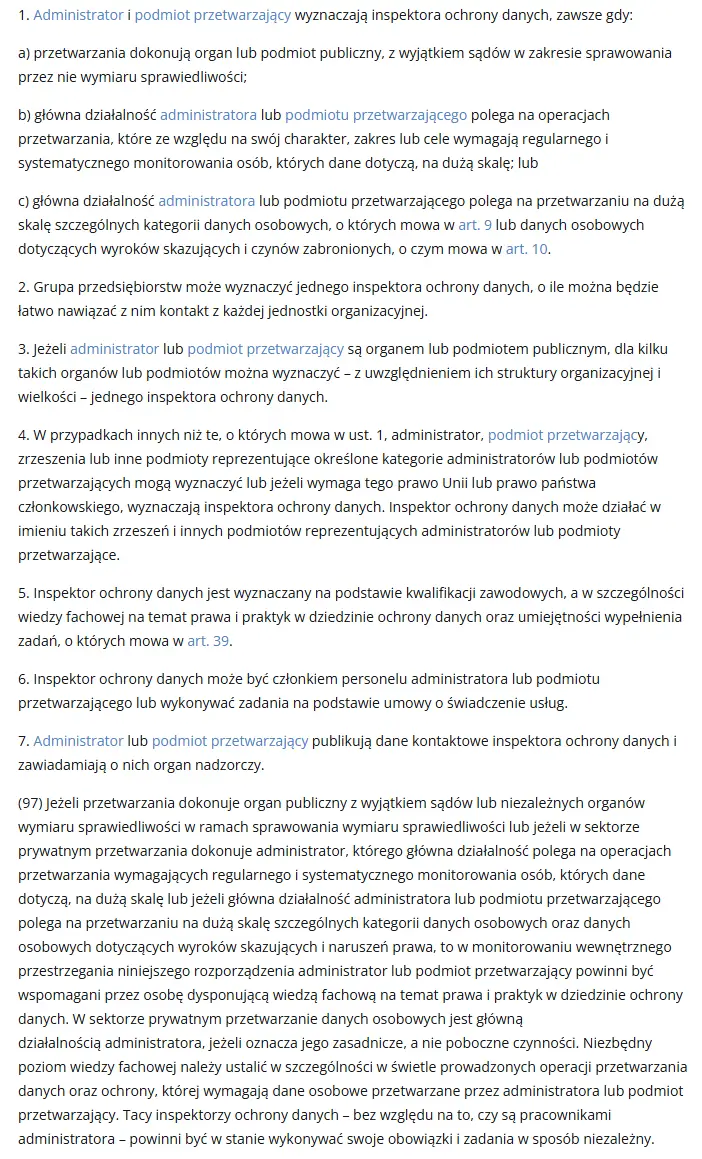
GDPR provisions – Article 37. Source: www.gdpr.pl/baza-wiedzy/akty-prawne/interaktywny-tekst-gdpr/artykul-37-wyznaczenie-inspektora-ochrony-danych
Soft skills
A DPO does not operate in isolation – their effectiveness depends on communication and collaboration skills.
Ideally, a Data Protection Officer should demonstrate the following qualities:
- the ability to build relationships with employees and management;
- project management skills related to data protection initiatives;
- determination in educating employees.
Statistics show that as many as 43% of data breaches result from human error, such as inadequate employee training1.
As Tomasz Ochocki, Vice President of the Management Board, ODO 24 points out:
"A DPO does not have to be a lawyer or an IT specialist, but should be able to effectively combine knowledge from both fields."
Requirements and practical experience
Although GDPR does not require DPOs to hold certifications, possessing internationally recognized certifications such as ISO/IEC 27001 is highly valued and enhances credibility.
Practical experience is equally important. Individuals serving as DPOs often have several years of experience in fields related to data protection, auditing, or IT security.
For many organizations, especially those that are only beginning their GDPR compliance journey, finding an employee who meets these requirements can be challenging. In such situations, DPO outsourcing becomes an excellent solution, providing access to specialists who can immediately and effectively support the organization in the area of personal data protection.
Practical responsibilities
An external DPO does not always know the organization inside and out, which is why cooperation with employees plays a crucial role. Employees should consult the DPO on all matters related to personal data protection that arise within their departments. Such communication enables the DPO to effectively carry out responsibilities such as:
- monitoring compliance of business processes with GDPR;
- responding to personal data breach incidents;
- conducting employee training sessions.
As Katarzyna Szczypińska, Data Protection Expert at ODO 24 states:
"A DPO is not only an expert but also a guardian – their role is to oversee the security of information at every stage of processing."
GDPR implementation and ongoing support
If your organization is just beginning its journey toward effective data protection, consider seeking professional assistance with GDPR implementation – a process that helps establish a structured approach to information security activities. For everyday challenges, ongoing GDPR support services can also be valuable, providing continuous guidance and assistance.
Summary
A DPO is more than just a job title—it is a mission. Remember that a DPO's effectiveness depends on the right combination of knowledge, experience, and interpersonal skills. A good Data Protection Officer embraces challenges and continuously develops their expertise.

