

How to conduct a service provider audit in the context of data protection?
Verifying a service provider is not optional—it is a necessity. Under Article 28 of the GDPR, before starting cooperation with a data processor, you must ensure that they meet personal data protection requirements. How can you do this? Below is a brief guide that explains step by step how to conduct such an audit.
1. Formal verification – start with documentation
Every service provider should be able to present appropriate documentation demonstrating compliance with GDPR requirements. First, pay attention to:
- personal data protection policy – a document describing the organization's data protection procedures;
- record of processing activities – allows you to assess what data is processed and for what purpose;
- certifications and compliance confirmations – such as ISO 27001.
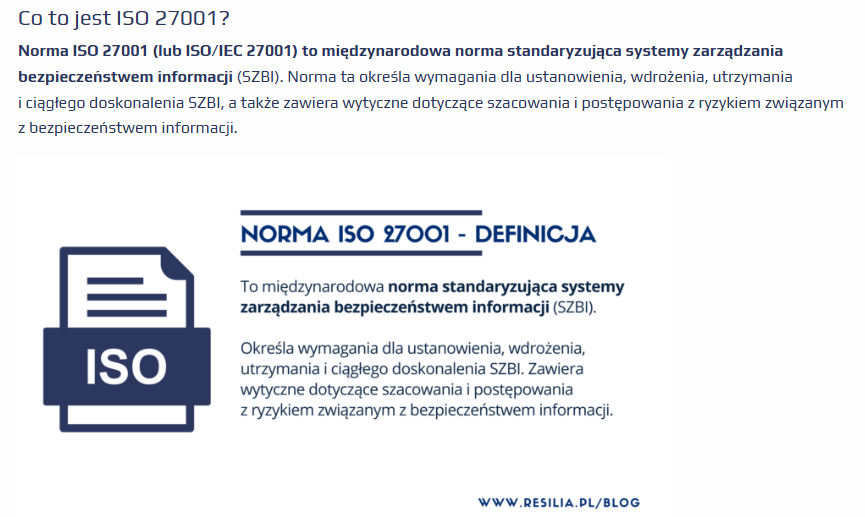
ISO 27001 – explanation. Source: www.resilia.pl/blog/iso-27001-czym-jest-jakie-daje-korzysci/
2. Technical security – do not ignore the details
Your data is only as secure as the provider's infrastructure. What should you verify?
- security systems – firewalls, data encryption (e.g., TLS/SSL), and backup mechanisms;
- data access controls – what user authentication procedures are in place?
- incident response capabilities – does the provider have a plan for responding to security breaches?
According to a PwC report from 2023, 74% of companies experienced a data security incident within the previous 12 months.
3. Process audit – ask questions
A discussion with the provider is a key element of the audit process. Ask about:
- the process for managing customer data;
- how procedures are updated when regulations change;
- employee training related to data protection.
Do not forget to assess how critical responsibilities are handled. By selecting a provider that offers DPO outsourcing, you gain assurance that data processing activities are subject to professional oversight. It is also worth noting that if you already have a DPO, they can help you assess and verify the data processor. Such activities may also be covered under DPO outsourcing services or ongoing support provided by organizations specializing in personal data protection.
4. Verification of GDPR compliance
The final step is confirming that the provider has actually implemented data protection principles. Particular attention should be paid to:
- the execution of a data processing agreement in accordance with Article 28(3) of the GDPR;
- the conclusion of a personal data processing agreement with the provider;
- completion of a security questionnaire by the provider, confirming the data protection measures they have implemented.
A statistic worth remembering
As many as 60% of businesses in Poland in 2022 did not have complete personal data protection documentation. Do not become part of that group—professional GDPR implementation is an investment that pays off.

