

How long does GDPR training take?
Implementing GDPR is not a one-time process. Employee education in data protection is essential to ensure compliance with regulations and avoid penalties. The duration of GDPR training depends on several factors, including the scope of the course, the participants' level of expertise, and the training format. It is also important to emphasize that GDPR training should be conducted regularly—typically every 6 to 12 months—to keep employees informed about regulatory updates and emerging data protection threats.
Basic GDPR Training – How Long Does It Take?
The most common introductory GDPR courses last between 2 and 4 hours. These sessions are designed for employees who process personal data in their daily work but do not serve as Data Protection Officers (DPOs).
If your organization requires a Data Protection Officer, you may consider DPO outsourcing.
As the Polish Data Protection Authority (PUODO) increasingly emphasizes the professionalization of the DPO role, individuals performing this function—or considering DPO outsourcing—must meet more advanced requirements.
PUODO expects DPOs to be properly qualified and to continually expand their expertise. As a result, basic training is generally insufficient for Data Protection Officers, whose knowledge should be updated regularly, typically every 6–12 months.
Topics covered in basic training include:
- responsibilities of a data controller;
- how to process personal data lawfully;
- procedures for responding to personal data breaches.
Advanced GDPR Training
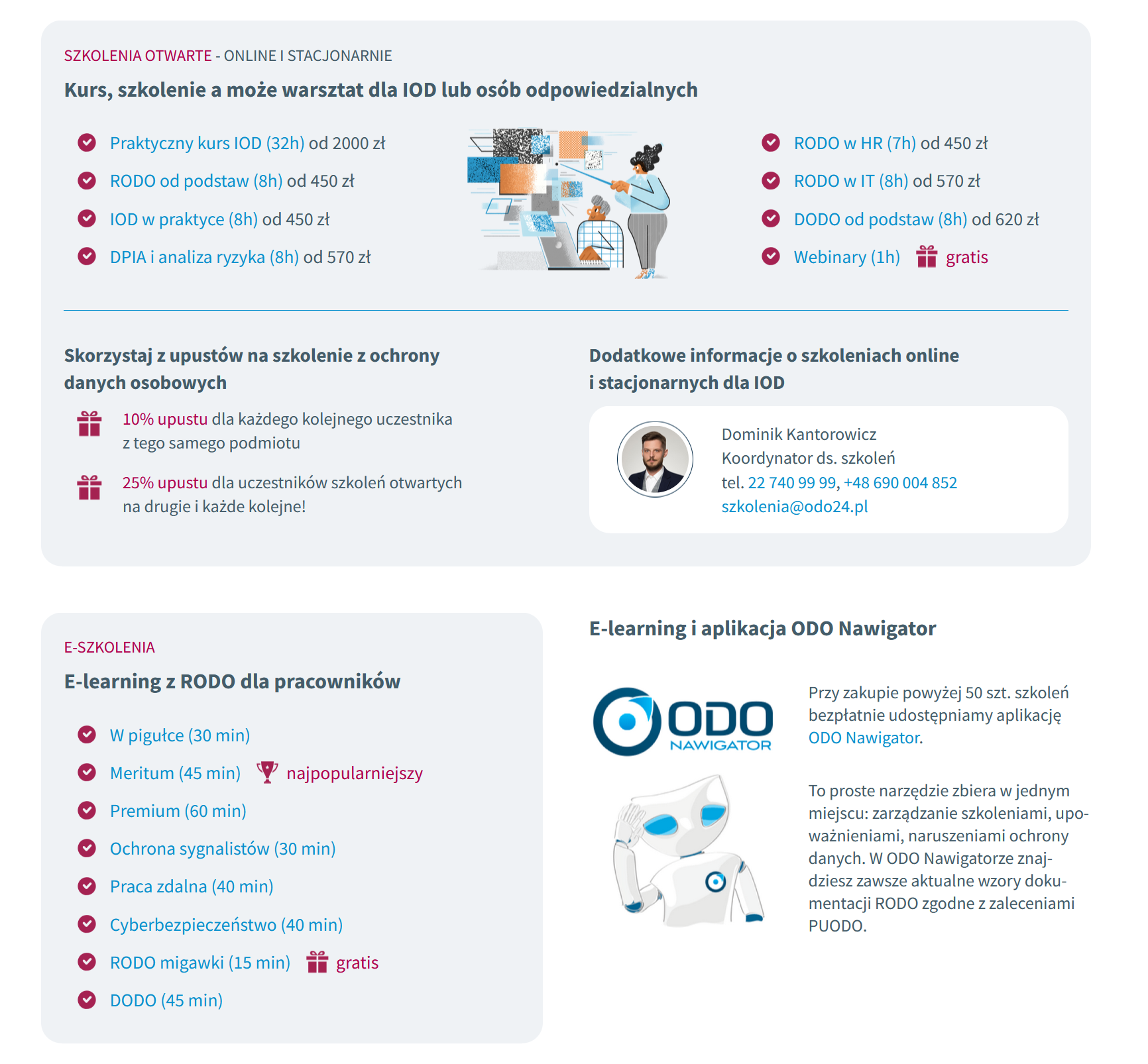
For managers, compliance professionals, and individuals responsible for data protection (including DPOs), more comprehensive training programs are available. These courses typically last 1–2 days and provide in-depth knowledge of GDPR audits, risk assessments, data protection documentation, and compliance management.
"The duration of training depends primarily on the level of complexity and the specific needs of the organization. At ODO 24, our offerings range from short GDPR e-learning modules lasting just a few minutes to practical DPO courses that can take up to 32 hours." – Paweł Radecki, Compliance Expert, ODO 24.
Explore our practical GDPR training courses and find out more!
Online vs. In-Person Training
Online Training
An increasing number of organizations choose online training because it is more flexible, easier to schedule, and adaptable to individual learning needs. A standard GDPR e-learning course usually takes around 3 hours, and participants can complete the material at their own pace.
In-Person Training
Classroom-based training requires attendance at a training venue and generally lasts longer, averaging 4–8 hours. Benefits include direct interaction with instructors, opportunities to ask questions in real time, and more effective discussion of complex compliance scenarios. This format is especially valuable for organizations dealing with sophisticated data protection challenges.
Recommended Training Frequency
To maintain compliance and employee awareness, GDPR training should be conducted:
- every 6–12 months as a refresher;
- during employee onboarding;
- after significant regulatory changes;
- following data protection incidents or breaches.
Summary
The duration of GDPR training varies depending on its purpose and audience:
| Training type | Typical duration |
|---|---|
| Basic employee training | 2–4 hours |
| Standard e-learning course | Around 3 hours |
| In-person workshop | 4–8 hours |
| Advanced GDPR training | 1–2 days |
| Practical DPO course | Up to 32 hours |
Regular training is just as important as the initial course. Continuous education helps organizations maintain compliance, reduce the risk of breaches, and ensure that employees remain aware of evolving legal and cybersecurity requirements.

