
What is outsourcing and where is it applicable?
Outsourcing involves delegating the entirety or part of activities aimed at achieving a specific business goal to an external company. Outsourcing can pertain to both the provision of core services (subcontracting) and supporting processes.
The most typical areas include:
- consulting and advisory services – relying on the expertise of specialists where we lack specialization (e.g., personal data protection),
- call centers – providing customer service, receiving and forwarding inquiries,
- accounting, HR, and payroll – utilizing efficient and proven solutions,
- archiving and disposal of documents, media, and devices – otherwise, each department does this on its own,
- logistics and transportation services – using an external fleet reduces risk and increases flexibility,
- IT services and solutions – the cost-effectiveness of using in-house developers and IT infrastructure is usually lower,
- marketing agencies – reaching customers is one of the biggest challenges, and a good agency is an asset against competitors,
- training companies – ensuring timeliness and relevance of mandatory training, as well as new perspectives and development of employee competencies.
When will we achieve savings?
Savings can arise from various factors, and comparing the salary of an in-house employee with that of an external expert can be misleading. If you want to make a good choice, pay attention to the following factors:
- service price – companies that utilize a proven and effective service method save both your time and their own. Generally, the more tailored the solution, the higher the price,
- scope of service – when we outsource tasks in areas where we lack expertise, misunderstandings are much more likely. We should pay attention to the transparency of the offer and hidden costs,
- relief of internal resources – when there is no external company, your employees must not only implement but also develop solutions themselves. Through outsourcing, they can focus on core activities,
- flexibility – business processes do not always require the same amount of work. Outsourcing allows for greater adaptation to needs than in the case of a full-time employee.
However, there will be no talk of savings if the quality of the service is too low. The costs of corrections, handling complaints, or even penalties for breaking regulations – all of this may lead us to regret trusting a particular company.
Sample comparison of the costs of a GDPR specialist's salary
with the cost of GDPR outsourcing
Cost components:
- Net salary
- Social security contributions
- Health insurance
- Tax
- Training budget
- Sick leave costs
- Employee Guarantee Fund
- Equipment/Software
- Benefits
- Office rental
- HR and payroll
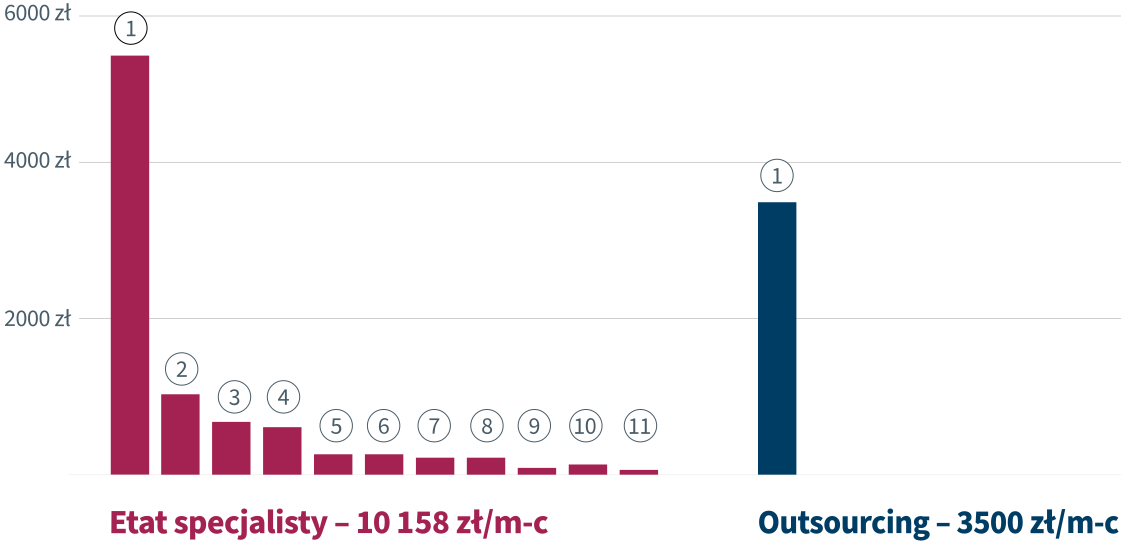
Source of information on the salary for the position of Data Protection Officer: wynagrodzenia.pl
When does outsourcing mean higher quality?
- When we want to take care of an area in which we do not specialize – often the only alternative is to train or change the specialization of our own employees. Even if we ultimately want to handle a given process ourselves, temporary outsourcing allows us to avoid turning our organization into a testing ground.
- When we need the highest certainty of solutions – even if we manage somehow, the experience of an external company in a narrow field provides the greatest assurance that no important aspects have been overlooked.
- When change is needed – internal employees are usually accustomed to the solutions already in place. An external company brings a new perspective and a breath of fresh air.
- When independence is needed – internal employees often face a conflict of interest: on one hand, they want to provide a legally compliant solution, and on the other hand, a business-effective one. An external company brings greater awareness of the risks the organization faces.
Who is outsourcing most beneficial for?
Outsourcing can be effective for anyone. A self-employed entrepreneur will not hire a second employee – they need savings. Organizations focused on efficiency want their employees to concentrate on core tasks. Meanwhile, a large-scale international corporation requires top-quality solutions. There are also situations where outsourcing compliance with GDPR is particularly advantageous, namely:
- groups of enterprises – solutions provided for one company are much easier to implement in other companies (the savings are even greater),
- shared service centers – often responsible for many processes and need to relieve their own resources,
- organizations with increased risk or large-scale operations – support from experts can make a difference at a critical moment, such as an incident or a supervisory authority inspection,
- organizations subject to multiple standards and guidelines (e.g., the Financial Supervision Authority) – so that employees can focus on core activities,
- organizations where one area is at a low level and for various reasons it is difficult to change this – hiring external experts usually elevates the project's status and motivates internal employees to embrace changes.
What should be taken into consideration?
Good outsourcing should mean that we operate better, have greater certainty, and more time due to effective collaboration. An external company should provide specialization, a developed methodology and action schemes, as well as greater independence and availability. The responsibility for selecting the company lies with us, which is why it is worth:
- asking about the methodology, materials, and tools – to what extent they will enhance our quality and efficiency,
- check the reputation and references (be wary of fraudsters and novices),
-
ask about the team composition (experts from all fields covered by the service should be designated for support),

Free knowledge about GDPR.
Use it freely!Webinars, articles, guides, training, snapshots, and assistance. Welcome to the ODO 24 knowledge base.I'M IN - ensure that the offer includes sufficient time to complete all tasks,
- make sure that consultants provide quick availability in case of an incident,
- verify whether the company has professional liability insurance,
- provide an efficient contact point within your organization,
- obtain information security guarantees and inquire about the issue of entrusting the processing of personal data.
Summary
Outsourcing is possible in virtually every process, and it most commonly occurs in areas such as compliance, HR, accounting, document circulation and archiving, fleet management, IT solutions, training, and marketing. When choosing a good offer and a reliable provider, outsourcing is usually a better solution than relying solely on internal resources and employees. Potential benefits include savings, relieving internal resources, better quality, flexibility, and independence.
However, this does not mean a complete transfer of responsibility and effort. Good outsourcing means that we know how to act, we have greater certainty, and more time thanks to effective collaboration. Support from experts can prove to be a key factor in critical situations, such as a supervisory authority audit.

